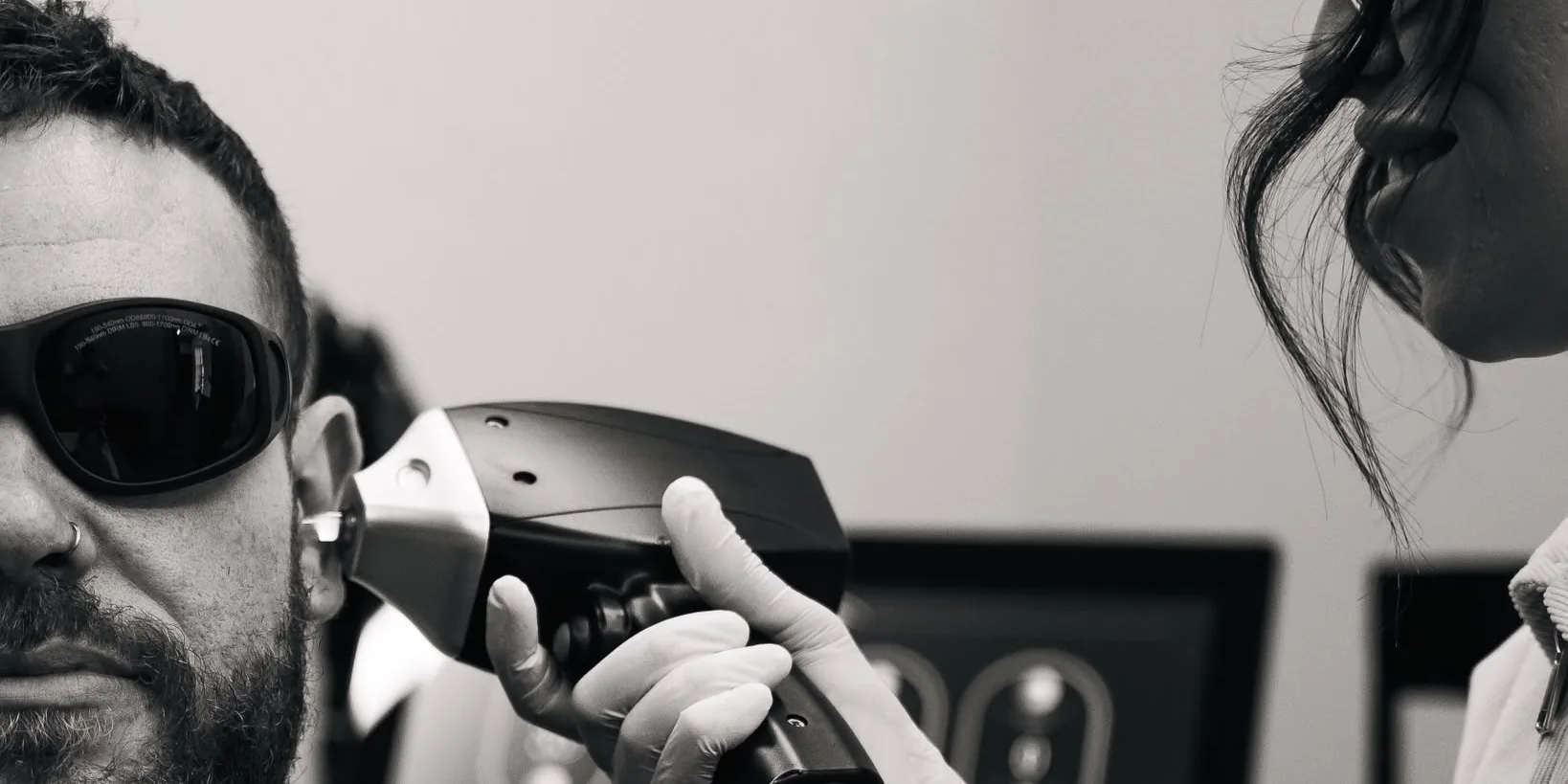
Laser hair removal is one of the most misunderstood treatments going, mostly because of how it's advertised. Here is what it actually does, what it doesn't, and why it has to be done as a course.
How it works
The laser targets melanin, the pigment that gives hair its colour. Light is absorbed by the pigment in the hair, converted to heat, and that heat damages the follicle enough to stop it producing hair as effectively.
That mechanism explains almost everything else about the treatment, including its limits. No pigment means nothing for the laser to target, which is why white, grey and most red hair doesn't respond. Blonde and very fine hair responds poorly for the same reason. Dark hair on lighter skin is the easiest case, but modern systems treat a much wider range of skin tones safely than older machines could.
Why it has to be a course
Hair doesn't all grow at once. Every follicle cycles between an active growing phase, a transitional phase and a resting phase, and at any given moment only a portion of the hair in any area is actively growing.
The laser only works properly on hair in that active phase. Everything resting is untouched, and will surface weeks later looking like the treatment didn't work. It did. It just couldn't reach hair that wasn't there yet.
That's why sessions are booked as a run with gaps between them, and why the gap is shorter on the face than on the legs. Different areas cycle at different speeds.
Reduction, not removal
The industry calls it permanent hair reduction rather than permanent removal, and that distinction is worth understanding before you spend anything.
A completed course typically leaves you with significantly less hair, finer and lighter than before. It doesn't usually mean never shaving again forever. Hormonal changes can wake dormant follicles later, and most people have a top-up session occasionally to stay where they want to be.
Anyone promising permanent removal in a fixed number of sessions is overselling it.
Before your session
- Shave the area the day before. The laser needs the pigment in the follicle below the skin, not the hair above it, and long hair on the surface just burns.
- Don't wax, pluck, thread or epilate for at least four weeks beforehand. All of those remove the root, which is the thing the laser needs to find.
- No fake tan for two weeks, and no sunbeds or sunburn.
- Come with clean skin, no deodorant, make-up or moisturiser on the area.
What it feels like
A quick hot flick against the skin, often compared to an elastic band. Most systems cool the skin as they work, which takes a lot of the edge off. Coarser areas and the face tend to be sharper than the legs.
Afterwards
Some redness and small raised bumps around the follicles are normal and usually settle within a day.
- Avoid hot showers, saunas, steam rooms and the gym for 24 to 48 hours.
- No sun exposure or sunbeds on the treated area, and use a high SPF on exposed skin.
- Between sessions, shave as normal. Don't wax or pluck.
- Treated hairs will often appear to grow for a week or two before shedding. That's them being pushed out, not growing back.
Who it isn't suitable for
- Anyone pregnant or breastfeeding.
- Anyone on medication that increases light sensitivity.
- Anyone who has taken oral isotretinoin in the last six months.
- Skin that is currently tanned, sunburnt or has fake tan on it.
- Active infections, wounds or skin conditions in the area.
- Areas with tattoos, which cannot be treated over.
Some conditions, including PCOS, can affect results and how much maintenance you need. It doesn't rule the treatment out, but it's worth raising at consultation so expectations are set honestly.
This page is general information, not medical advice. Suitability depends on your skin, your hair and your health, and is assessed in person at consultation.